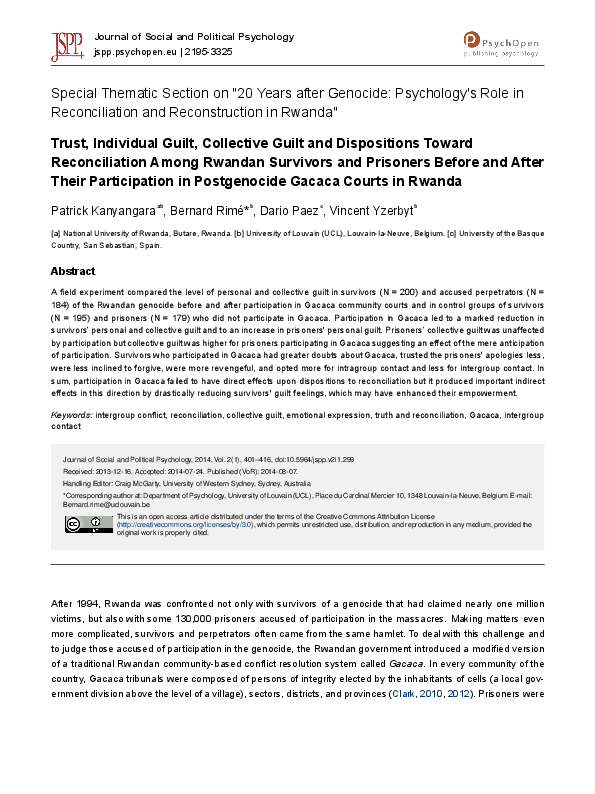
Trust, individual guilt, collective guilt and dispositions toward reconciliation among Rwandan survivors and prisoners before and after their participation in postgenocide gacaca courts in Rwanda
Key facts
Intergroup relations
Other (Guilt, Empowerment, Reconciliation)
Summary
A field experiment compared the level of personal and collective guilt in survivors (N = 200) and accused perpetrators (N = 184) of the Rwandan genocide before and after participation in Gacaca community courts and in control groups of survivors (N = 195) and prisoners (N = 179) who did not participate in Gacaca. Participation in Gacaca led to a marked reduction in survivors’ personal and collective guilt and to an increase in prisoners' personal guilt. Prisoners’ collective guilt was unaffected by participation but collective guilt was higher for prisoners participating in Gacaca suggesting an effect of the mere anticipation of participation. Survivors who participated in Gacaca had greater doubts about Gacaca, trusted the prisoners' apologies less, were less inclined to forgive, were more revengeful, and opted more for intragroup contact and less for intergroup contact. In sum, participation in Gacaca failed to have direct effects upon dispositions to reconciliation but it produced important indirect effects in this direction by drastically reducing survivors' guilt feelings, which may have enhanced their empowerment.